8 switchable outputs
Switch suitable 12 V devices centrally. The documented limits for each output and the total system still apply.

YOUR CAMPER. YOUR IDEAS. E1NS.
The open platform for your smart camper.
E1NS brings together control of suitable electrical devices, battery data and sensors. One app makes it easy to understand.
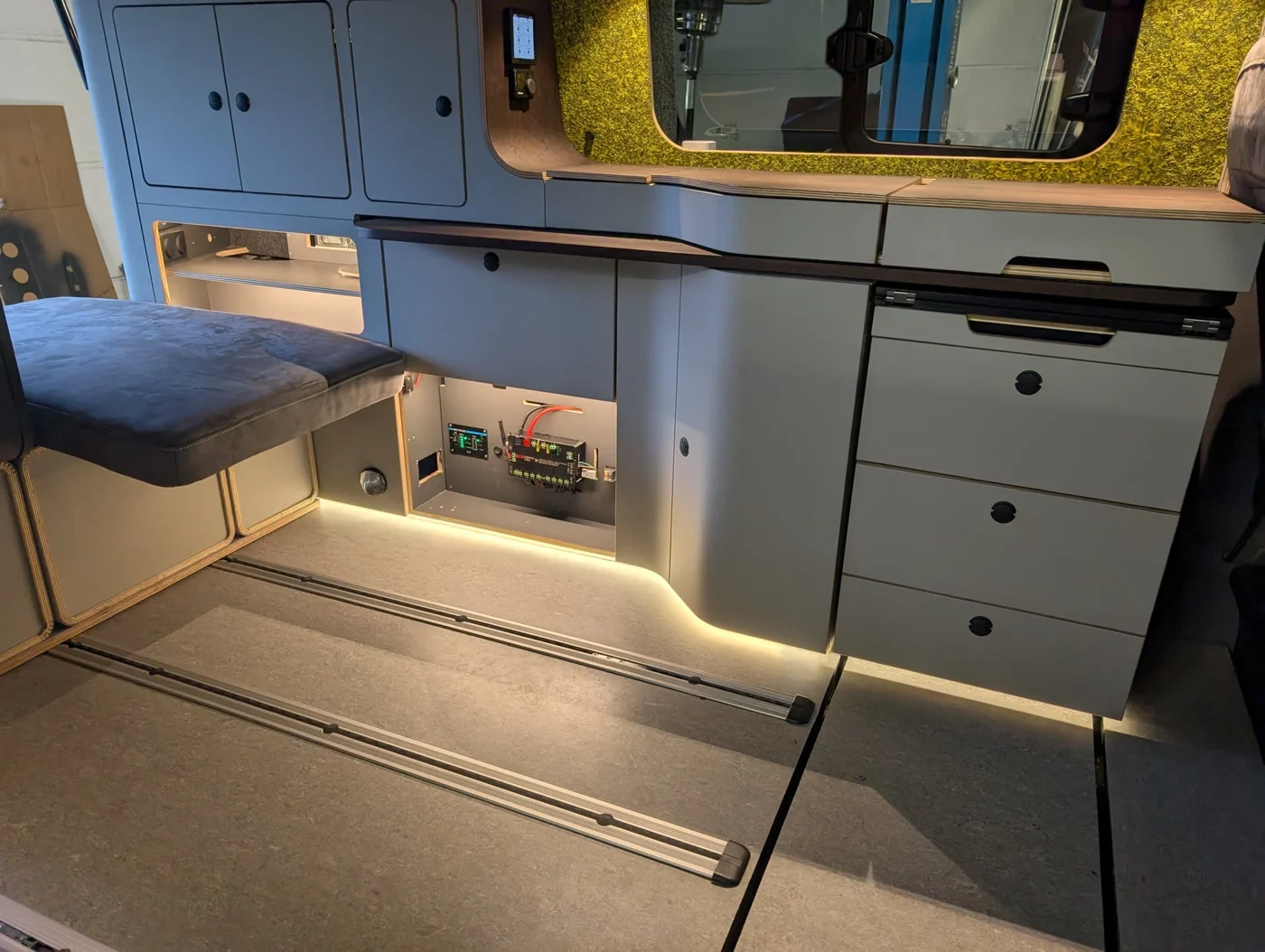 Enlarge installation photo
 PLENTY ALREADY INCLUDED
Switch suitable 12 V devices centrally. The documented limits for each output and the total system still apply.
Monitor voltage, current and battery status. Measure temperatures with the included sensors.
Use it locally via Wi-Fi. LTE and GPS are part of the hardware; add a SIM card, data plan and appropriate setup as needed.
YOUR ELECTRICAL SYSTEM. CLICK BY CLICK.
What goes into your camper?
Add devices. Follow their connections. Discover what E1NS takes care of – and how your build can grow.
Try it here. Your selection stays on this page.
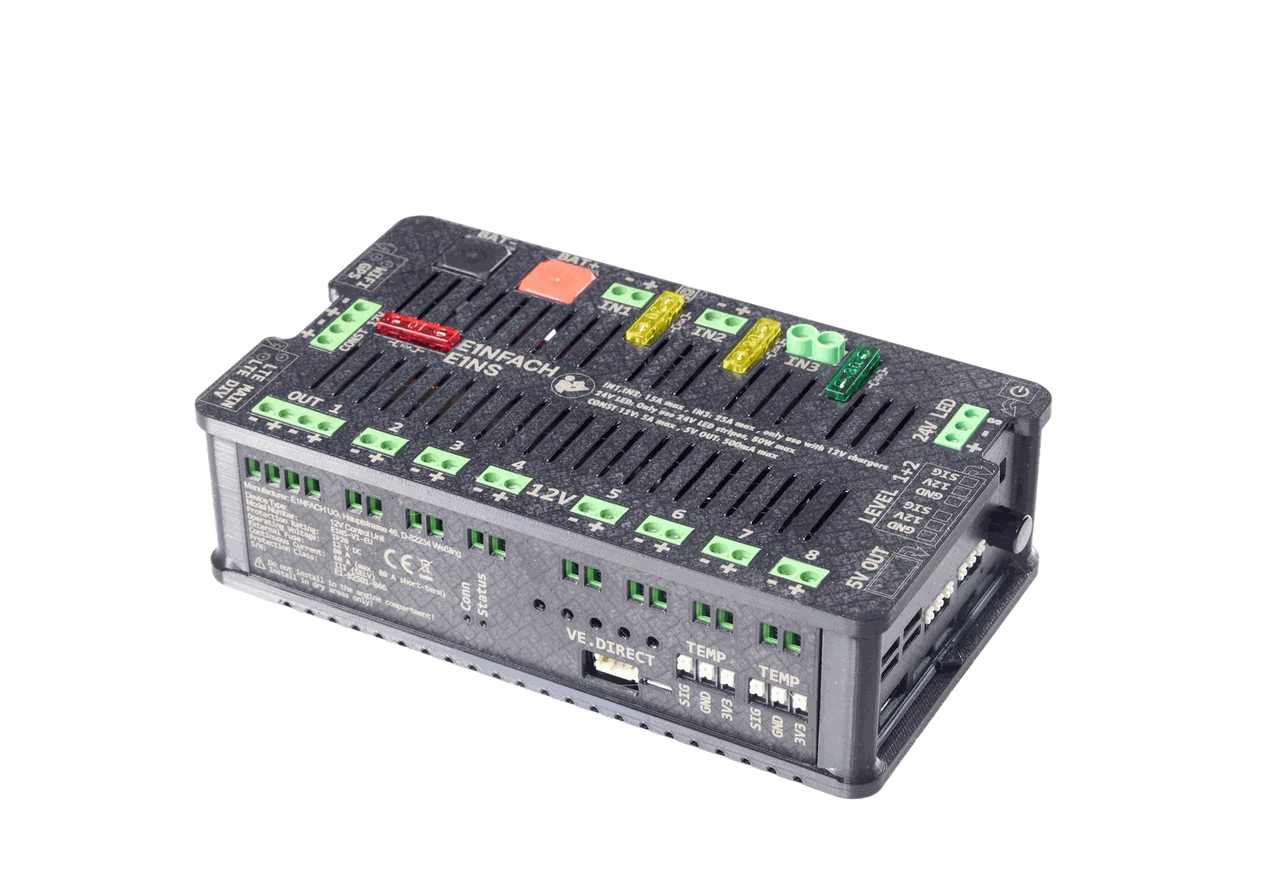
Leisure battery → E1NS → suitable 12 V devices. The box measures its own branch. Observe 15 A per switched output, 30 A per group of four and 60 A in total.
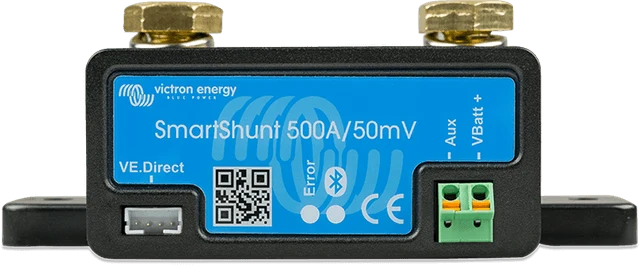
A large inverter needs its own fused connection. A compatible SmartShunt in the common negative cable supplies battery data to E1NS via VE.Direct. The box's current limits stay the same.
The interactive builder requires JavaScript. You can still read the connection principles and documentation. Open the installation guide →
Up to 15 A per output. Two banks of 30 A each: OUT 1–4 and OUT 5–8.
If your build needs more, the example shows an additional battery branch outside E1NS. The current through the box still stays within 60 A — even with a SmartShunt.
The virtual fuses use Infineon power switches. They provide overvoltage, overcurrent, overtemperature and short-circuit protection, as well as reverse-polarity detection. In the app, you set each output’s current limit, up to 15 A. Each bank remains limited to 30 A, and all outputs together to 60 A.
What would you like to add?
Tap a device. Discover its connection.2 of 8 loads · 2 E1NS outputs used
Your compact setup is ready.
12-V-Beispiel · Anschlussprinzip
Want to learn more about a cable? Hover over it or tap it.
The 12 V loads, solar charge controller and shore power charger connect directly to E1NS with both positive and negative cables. Lines show connections, not cable sizes. Small bridges indicate crossings without a connection. Sensor and auxiliary connections are simplified. The installation guide shows the individual connections.
A Wi-Fi bus module from another manufacturer has been announced. It is not yet available. We will explain supported devices and features when the add-on launches.
The images show real devices and connection illustrations. Currents are example values, not binding specifications of the pictured models. The calculation assumes simultaneous operation in a 12 V system. You can add up to eight 12 V loads in total. Each additional device has its own example current and uses its own free output. If it exceeds the remaining bank capacity, it is shown entirely in an external branch, never split across several outputs. Small auxiliary loads, self-consumption, starting currents and cable losses are not included.
The inverter calculation assumes 90 percent efficiency. The 20 A DC-DC charger connects directly to IN3, rated at a maximum of 25 A. Its charging current is measured internally. The alternative 30 A DC-DC charger exceeds this input and connects externally; a SmartShunt is recommended to include its charging current in the overall measurement. The SmartShunt measures the entire battery current in the common negative return. Switching here demonstrates the principle; actual configuration takes place in the E1NS app.
Explore the connection principles here. You will find the relevant connection details for your build in the installation guide.
Your idea goes beyond this example?
Let's look at your build together.
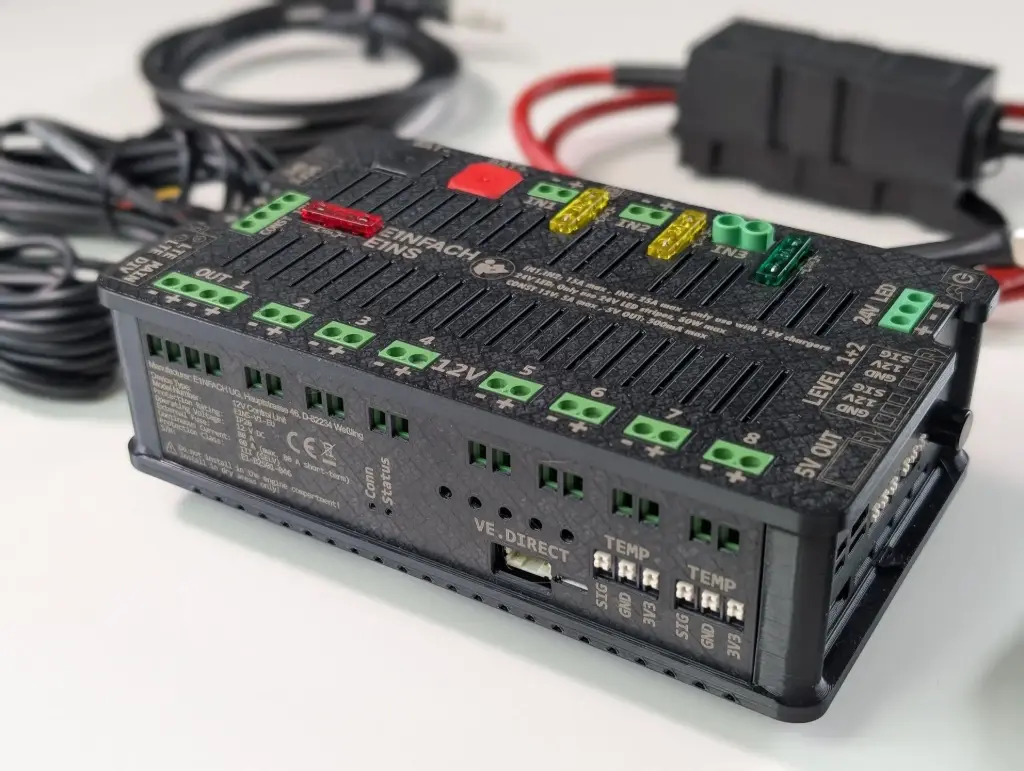
YOUR START IN SMART CAMPER ELECTRICS
The central hardware for your build – with a clear list of included accessories.
949.00 €
Price according to the current shop price list. See the product page for tax details, availability and delivery time.
View the complete kitBattery, devices, additional sensors and a SIM card with a data plan are not included. Plan the wiring to suit your vehicle.